Take a moment and think of a picture showing a GP at work.
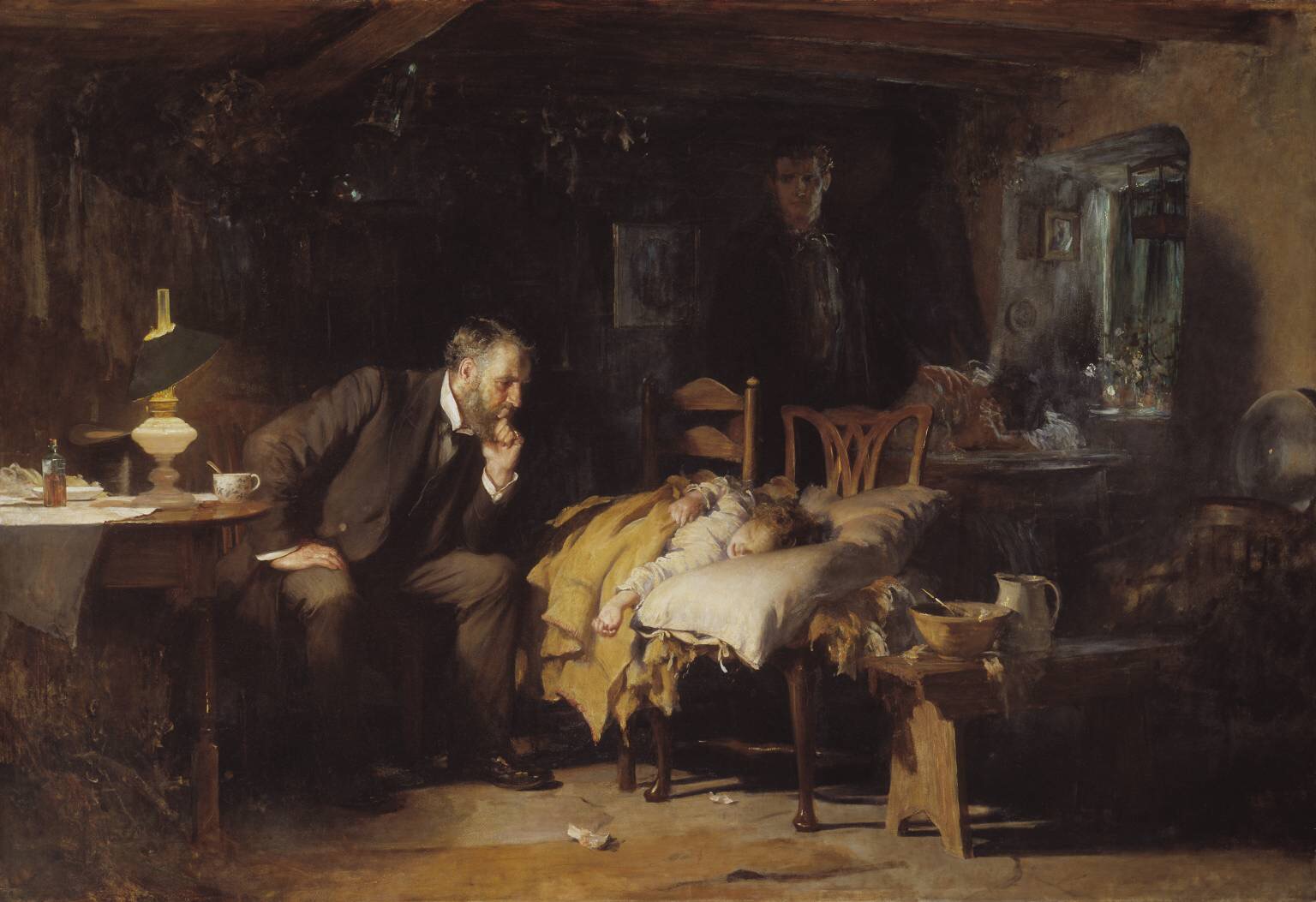
The chances you thought of Sir Luke Fildes 1891 painting “The Doctor.”
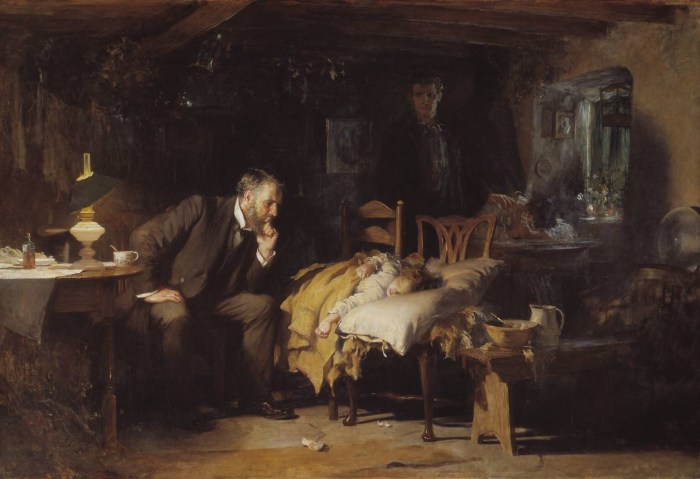
The picture was inspired by what the artist described as the heroism of Dr Murray, their family GP, who cared for his own first born son when he died.
In the picture Sir Fildes placed the events in a fisherman’s cottage at dawn, to symbolise the beginnings of hope for this family as the child shows the first flickers of recovery.
It became hugely popular with late Victorian society and prints and engravings of it were best sellers at the time, and it remains one of the most memorable images of the work of a GP.
One of the things that strikes you is that the doctor is smartly dressed even thought it is dawn, and he is in someone else’s house presumably at some distance from his own more salubrious residence.
Someone has raced to the doctor’s home, before sunrise, let us assume it was the father. He roused probably the whole household and persuaded the doctor, despite any evident ability to pay other than in fish, to come to his home and see what could be done, what the signs that have been observed by the parents portent.
In 2016 what would this fisherman and his wife do if they lived in New Zealand?
After hours GP services, even in large cities, are as rare as hen’s teeth. Rural services have centralised into regional towns, urban GPs have devolved this care to larger accident and emergency centres that often close at 10.00pm, home visits if done at all, are confined to the dying, and often only undertaken during the working day.
It is extremely unusual to find a GP who is prepared to even answer the phone to a patient after their clinic has closed.
You cannot pay for an ambulance journey with fish.
In 2016 this family would most likely wait it out, see what happened, hope for the best. Like most of the people in poverty they probably don’t have their own car, if they were really worried they might rouse a neighbour, and take the child to the nearest emergency department of a hospital.
It seems clear what the patients have lost by the inability of our health system to provide after hours GP services, but what has the system lost, and what has our profession lost?
Our small rural town is in the throes of losing our GP after hours service. The vision for the future given by the District Health Board and Primary Healthcare Organisation is one where a nurse and paramedic provide extended hours services until 10pm and the emergency department 45km away provides care from then until the GP clinics open in the morning.
This plan has been driven by the economic fact that after hours care does not make money and the small business model of care we rely on in New Zealand allows GPs to opt out of after hours services at little or no cost. We have also witnessed a dilution of professional ethics and values to the point where some GP colleagues feel justified in closing their doors at 5pm and leaving “emergency care” to the “emergency” service.
For some of us this national transition has been very hard, and some still stand against the tide of this change like King Cnut.
We have just come to the end of the holiday season when my colleague and I have provided on call services on a 1:2 basis to our community.
Our “emergency” services over this time did deal with motor vehicle accidents, several of them, one involving nine people and three cars ! We were involved in attempting, and failing, to resucitate and new born child.
The “bread and butter” of our service was to holiday makers with hangovers, fishhooks in their skin, people with rashes and infections and worries, lots of them.
I appreciate that what we have done is not sustainable, we cannot keep on working a 1:2 on call roster. It is physically tiring, emotionally draining, and we know that over work leads to poor judgement and burnout.
But what will we lose when we no longer can do what Dr Murray did for Sir Luke Fildes and his family ?
By “being there” during the failed resuscitation, simply being there as a doctor, you provide assurance for the family that everything that could be done was being done.
By “being there” you provide reassurance for the nurses, ambulance officers, firemen and others people supporting and helping that they are doing the right things.
By “being there” you provide the level of expertise, experience and skill to know when to say stop and allow the family to begin to grieve.
At the motor vehicle accidents we saved lives,mint is not exaggerating to say that whilst waiting for the ambulances to arrive we provided essential life support to critically injured patients who would otherwise have died.
For the numerous people who saw us with their “minor” ailments we saved a 90km round journey and a 4-8 hour wait in the emergency department to see a doctor, and we helped them enjoy their holiday.
When we stop providing after hours care as a profession we lose some of the respect we rightly hold in the eyes of our community, we lose the skills we have acquired to help people survive, we lose the excitement and thrill of providing essential care, we lose the satisfaction we get in a difficult job well done, and we lose some of the sense of professional pride we hold when we defend the role of the GP from those who still see it as a lazy, money grabbing, easy ride.
What does our system lose?
I think this is yet to be seen, I think “the system” hopes it will be cheaper, but I don’t think the system will gain much in terms of cost savings.
Someone has to do the work. Someone has to be trained to “be there” in the same way. The need for care is not going away.
In the UK it seem they are struggling to reinstate the seven day a week GP service. Costs and workforce issues make it really hard to put back in place what you once had, but good luck to them.
We will work in our small rural community in 2016 to make the best of what we have, to provide the best service we can for our community, in our community. I don’t think we will be doing a 1:2 on call next Christmas, but I do know that whatever services we have in place, there will be a GP involved.
We are too important.
We need to “be there.”


 Don't Shoot..